In many rural communities, healthcare is not absent. It is distant.
Distance here is not just measured in kilometers. It is measured in bad roads, transport costs, delayed referrals, and patients who arrive too late.
For millions of people, access to care depends not only on hospitals being built—but on healthcare being able to move.
Portable medical equipment is quietly reshaping this reality. It is breaking barriers that bricks and mortar alone cannot solve.
When Healthcare Cannot Wait for Infrastructure.
Building a fully equipped hospital in every rural community is ideal. It is also slow, expensive, and often unrealistic in the short term.
In the meantime, patients need:
- Diagnosis close to home
- Emergency stabilization before referral
- Antenatal monitoring without long travel
- Basic laboratory testing within reach
Portable equipment allows care to travel where infrastructure has not yet caught up.
Mobility Changes the Equation.
Portable medical devices are not smaller versions of “real” hospital equipment. They are strategic tools designed for flexibility.
Examples include:
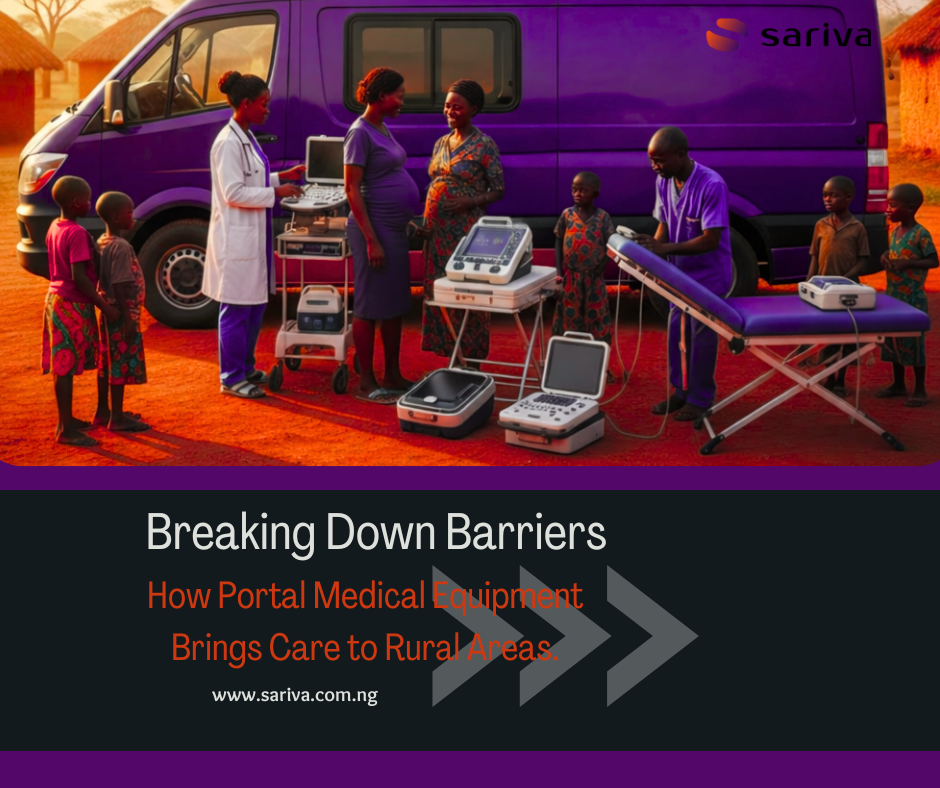
- Portable ultrasound machines for antenatal and emergency assessment
- Handheld ECG devices for cardiac screening
- Compact oxygen systems for emergency stabilization
- Mobile laboratory analyzers for rapid testing
- Portable patient monitors for outreach programs
These tools allow healthcare workers to deliver timely care during outreach clinics, mobile medical missions, and in primary health centers far from urban hubs.
Earlier Diagnosis, Better Outcomes.
In rural settings, delays are common. A condition that could be managed early often worsens because diagnosis came too late.
Portable equipment changes that timeline.
When a midwife can perform an ultrasound in a community clinic, high-risk pregnancies are identified earlier. When basic lab tests are available locally, infections are treated sooner. When oxygen is accessible in small facilities, emergencies are stabilized before referral.
Access shortens the distance between symptoms and treatment.
The Nigerian Reality.
In Nigeria, rural healthcare faces familiar challenges:
- Long travel distances to tertiary hospitals
- Limited specialist availability
- Inconsistent power supply
- High out-of-pocket transport costs
Portable equipment does not eliminate these issues, but it reduces their impact.
Battery-operated devices, compact systems with low power requirements, and equipment designed for rugged environments make it possible to provide meaningful care even in resource-limited settings.
But portability alone is not enough. Equipment must be durable, easy to maintain, and supported locally. Otherwise, it becomes idle technology.
Care That Moves with the Community.
Healthcare delivery is evolving. Outreach programs, community health campaigns, and mobile clinics are becoming essential extensions of hospital systems.
Portable equipment supports:
- Preventive care
- Maternal and child health services
- Chronic disease screening
- Emergency response in remote areas
It allows healthcare to meet patients where they are, instead of waiting for them to overcome geographic and financial barriers.
Bringing Healthcare Closer.
At Sariva Healthcare, portable medical solutions are selected with practicality in mind. Durability, ease of use, power adaptability, and service support are considered alongside clinical capability.
Because in rural healthcare, equipment must do more than function.
It must travel.
It must endure.
And it must work when access depends on it.
Breaking down barriers is not always about building new walls.
Sometimes, it is about removing the distance between care and the people who need it.