Most healthcare equipment decisions start the same way.
“How much does it cost?”
It’s a fair question. Budgets are tight. Margins are thinner than most people realize. Every purchase feels like a trade-off.
But in healthcare, cost and value are rarely the same thing. And when they are confused, the consequences show up quietly; in downtime, repeat purchases, staff frustration, and patient risk.
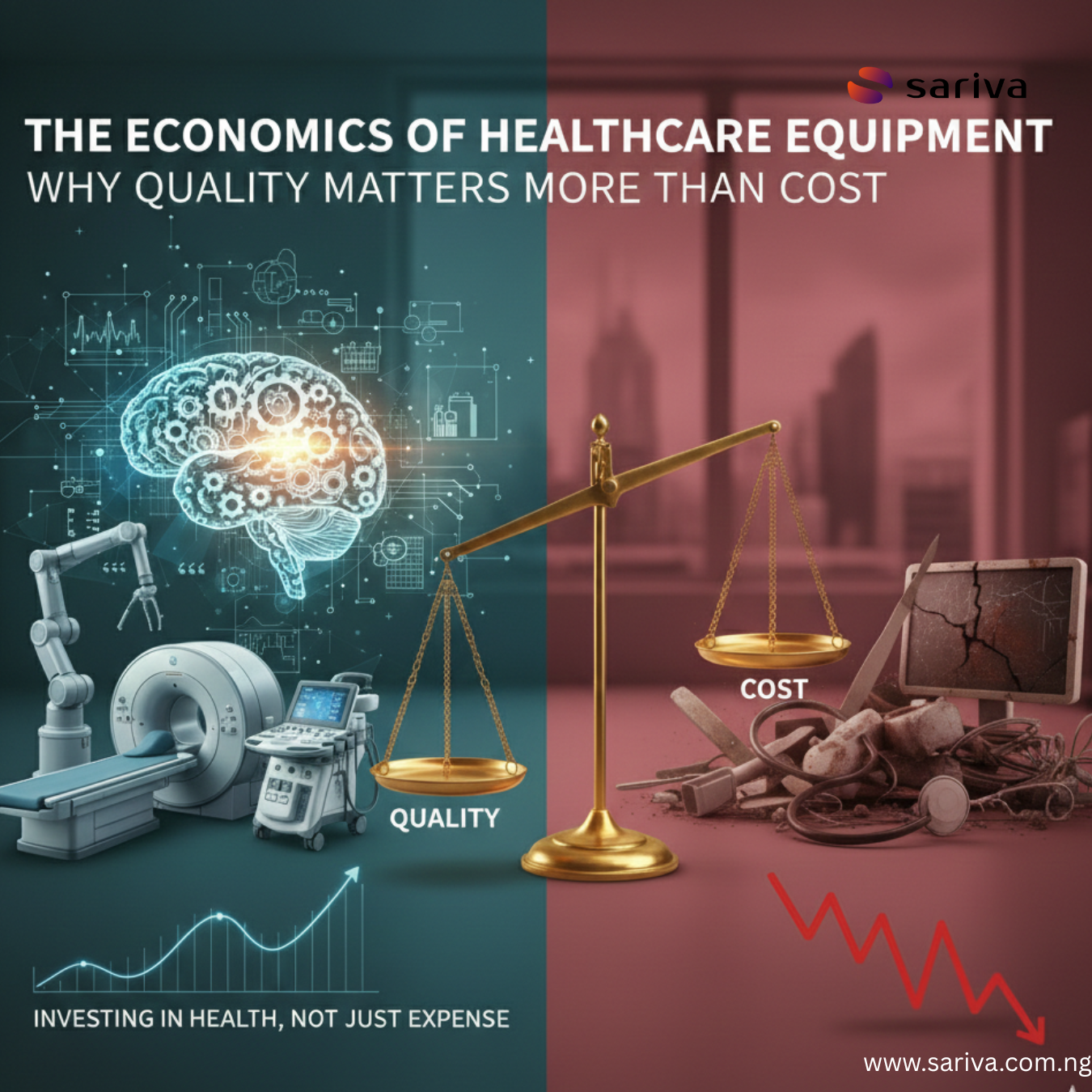
This article looks at the real economics of healthcare equipment, and why quality often ends up being the less expensive choice.
The Nigerian Reality: Unstable Systems, High Demands.
Healthcare equipment in Nigeria operates under pressure.
Power supply is inconsistent. Water quality varies. Technical support is not always close by. Patient volumes can exceed design capacity.
In this environment, equipment must be resilient. Devices that perform well in ideal conditions may fail quickly when exposed to local realities.
Cheap equipment tends to struggle with:
- Power fluctuations and voltage instability
- Heavy daily usage
- Limited access to spare parts
- Delayed technical support
When equipment fails, care is disrupted. And disruption in healthcare carries real consequences.
Downtime Costs More Than Repairs.
In many hospitals, when a critical device breaks down, there is no immediate replacement.
Procedures are postponed. Patients are referred elsewhere. Revenue is lost. Trust is damaged.
Downtime affects:
- Patient flow and waiting times
- Staff morale and efficiency
- Hospital credibility in the community
These losses are rarely captured during procurement discussions, yet they shape daily hospital operations.
Short-Term Savings, Long-Term Spending.
Low-cost equipment often comes with hidden expenses:
- Frequent servicing
- Replacement parts that are hard to source
- Short operational lifespan
- Repeated repurchasing
Hospitals end up spending more over time, while dealing with constant interruptions.
Quality equipment, on the other hand, is designed to endure local conditions. It lasts longer, performs consistently, and reduces unplanned spending.
Support and Service Are Not Optional.
In countries with strong technical infrastructure, equipment failure is inconvenient. In Nigeria, it can be crippling.
Quality equipment decisions must consider:
- Availability of local service engineers
- Access to spare parts within the country
- Clear maintenance plans
- Training for in-house staff
A machine without support is just a liability sitting in a room.
Thinking Beyond the Purchase Price.
In Nigerian healthcare, equipment economics should be measured by total impact, not initial cost.
Quality delivers:
- Stability in operations
- Predictable maintenance expenses
- Better patient outcomes
- Stronger institutional reputation
Cost-focused decisions may look good on paper, but they rarely survive real-world use.
Choosing Equipment That Works.
At Sariva Healthcare, equipment selection is guided by local realities. We consider durability, power tolerance, service availability, and long-term usability within Nigerian healthcare settings.
Because in Nigeria, healthcare equipment doesn’t just need to work.
It needs to keep working.